



Jobenomics believes that the economy is the most important issue facing American voters. A strong economy allows us to be secure and create the lifestyles that we desire. In the not so distant past, there was relatively little difference between the political parties. Today, the chasm between the parties is vast—leaving many Americans in a quandary regarding for whom to vote.
Recent political campaigns recently have been more about labeling than solutions. In modern politics, labeling fits well in a 20-second TV and radio sound bites. Americans rely on labels, brands and phrases to establish the goodness or badness of a product, person or community. Consequently, let’s examine labels relating to the politics relating to the economy.
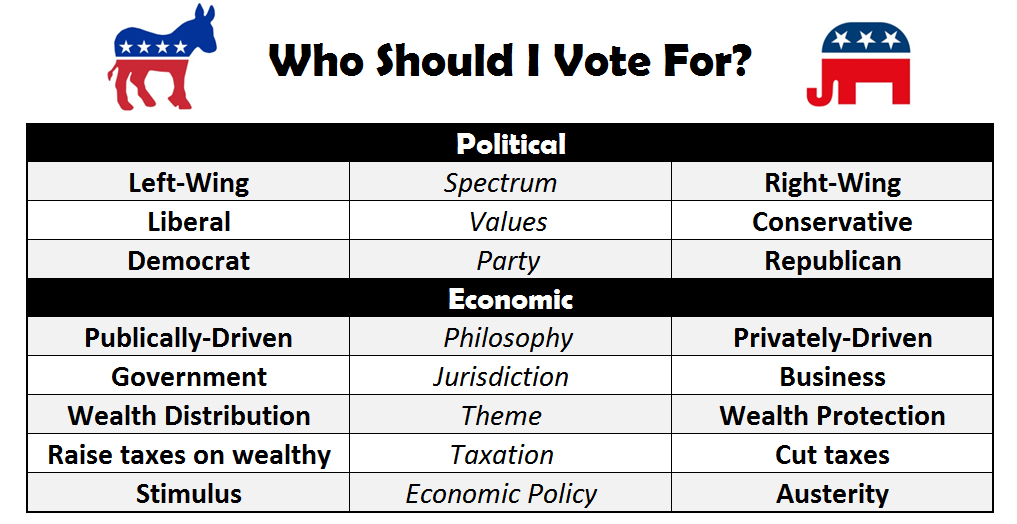
The political spectrum is often defined as left or right wing. The terms “left” and “right” can be traced back to 16th Century Europe where politicians were grouped by those loyal to the King and those advocating reform or independence. In contemporary times, the left-wing is associated with liberals, progressives, greens, social democrats, socialists, communists, and anarchists. The right-wing is associated with conservatives, capitalists, reactionaries, nationalists, as fascists. Clearly there is a wide spectrum of categories in each the left and wing. That is why labeling is so effective. President Obama defines himself as liberal Democrat, which puts him left of center. His opponents want to portray him as far-left of center, so they use the label of socialist. Governor Romney has declared himself as a conservative Republican right of center. His opponents want to portray him as far-right of center use reactionary labels. Since there is no consensus on the meanings of political labels, it is up the voter to determine how far right or left a candidate is and whether that is a good or bad attribute.
Economically, Democrats tend to promote a public sector driven philosophy over a private sector driven philosophy that is promoted by Republicans. In the past, both Democrats and Republicans alike generally supported a minimalist government role in the economic affairs of the private sector. The historic election of a president firmly rooted in publically-driven philosophy set the stage for a new dialog on the role of government vis-à-vis the private sector. However, it was the Great Recession of 2008 that was the real catalyst for change. The magnitude of the recession and the stagnant recovery has given voice to those on the left that promote a greater governmental role. Moreover, the ranks of those dependent on government (government workers, unemployed, under-employed, entitlement/welfare recipients) as well as those subsidized by government, are becoming the new majority.
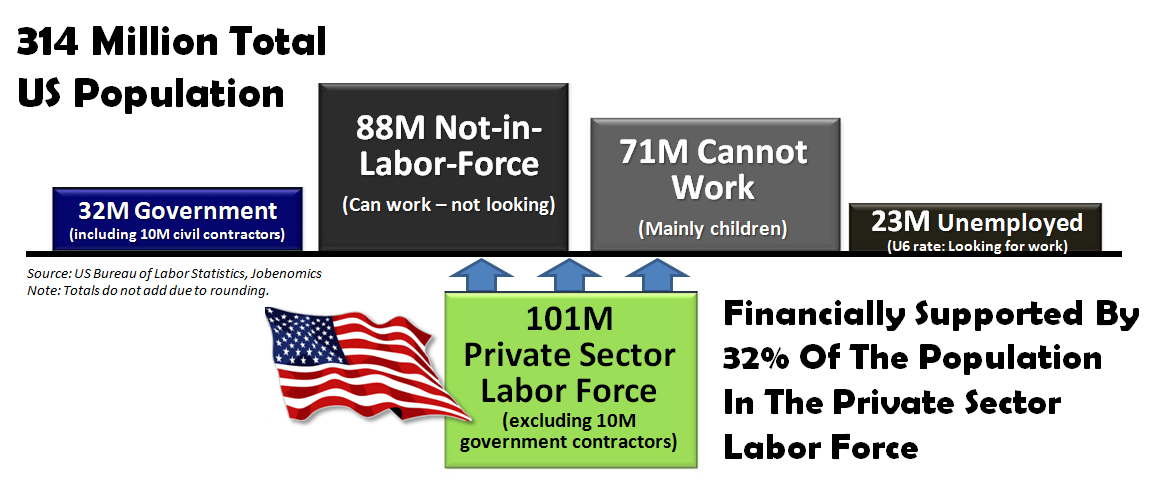
Today, only 32% of all Americans financially support the rest of the country. Out of a population of 101 million workers in the private sector are supporting 32M that work for government (including contractors), 88M that can work but choose not to work, 71M that cannot work (children, retired, disabled, etc.) and 23M that are looking for work (officially unemployed and unemployed). See Jobenomics Employment Scoreboard posting for more detail.
Given this economic distribution, the left argues that the need of the many outweigh the few (especially given the historically high degree of income inequality). The right argues that too few pay for too many (which may lead to an economic collapse). American voters are at a crossroad. The road to the right is largely the road that we have traveled. The road to the left represents an economic inflection point—a point of change.
Those on the left who yearn for a public economy generally favor increased government involvement, egalitarianism, regulation of business, wealth distribution, robust government spending, taxation and stimulus packages focused on resolving economic inequalities. Those on the right tend to favor limited government involvement in the private sector, the free market system, limited taxation, deregulation of commerce and industry, and increased austerity measures regarding entitlement and welfare programs.
So, which path does Jobenomics endorse? Jobenomics is a bipartisan, centrist movement that deals with the economics of business, job, wealth, and tax revenue creation with a goal of creating 20 million new private sector jobs by year 2020. As such, Jobenomics promotes a middle way.
In regard to a public or private economy, Jobenomics leans center-right. Jobenomics favors a private/public partnership where the private sector leads and the public sector supports. With the exception of times of crisis, government’s role in big business should be minimal. On the other hand, government needs to play a greater role in small, emerging and self-employed business creation—America’s economic engine. Financing to the base of the America’s economic pyramid is needed. Almost all of government’s recent stimulus, bailout and buyout program funding went to financial organizations and large corporations. Little went to small business. To make matters worse, now healthy banks are more restrictive in their lending practices, and big businesses are hoarding cash. Initiatives, like the Jobenomics Community Based Business Generators and Jobenomics Women-Owned Businesses that are designed to mass produce small and self-employed businesses, are needed. Government also has a role in investing in research and development that is the lifeblood of hi-tech small businesses. Rather than touting shovel ready highway projects, government should focus on the next-generation broadband super highway.
In regard to higher taxation, Jobenomics leans center-left. An eroding middle class leaves only the rich to bear the tax burden. However, Jobenomics does not favor transferring the wealth to government bureaucrats. Instead, rich individuals and corporations should be offered incentives to invest in community business generators, business incubators and vocational training programs. Big business has trillions of dollars of cash and even more trillions that could be repatriated from foreign business accounts. Jobenomics is not suggesting social charity. Instead, community investments by the rich could be in the form of debt (micro business loans) and equity financing that would maximize the potential for a win/win/win for small businesses/big businesses/local communities. The rich know how to maximize return on investment.
In regard to austerity programs, Jobenomics is neutral. There is no doubt that the soaring national debt is an economic albatross that will eventually cripple or topple the American economy. On the other hand, there were over 350 million welfare and entitlement annual payments (51M social security, 45M Medicare, 59M Medicaid, 44M food stamps, etc.) are made to financially distressed Americans. Considering that the total population is only 314 million, this surreal number begins to give scope to the growing divide between haves and have-nots. An austerity program is needed but should be implemented slowly to keep from upending the fragile recovery. In the near-term, Jobenomics supports capping spending on the major entitlement programs and seeking savings on non-essential discretionary programs. For essential programs, like national security, it is time that we look at reorganizational efforts of the magnitude of the National Security Act of 1947.
So who should I vote for? The answer is the one who comes closest to the center.