
Jobenomics

Goal: Creating 20 Million Jobs By 2020

Not in Labor Force (NiLF)

This posting addresses the fastest growing US labor category known as Not-in-Labor-Force.  Highlights include:

  • 89 million people are now in an official government labor category called Not-in-Labor-Force (NiLF).  NiLF people can work but chose not to work.
  • By 2020, given current trends, those in the NiLF will outnumber all the people in the private sector work force.  The US economy cannot sustain the overhead of people that can but do not work.
  • Sooner or later, the American people will figure out that the current way our government calculates unemployment is seriously flawed.  Under the current system it is theoretically possible for the US to have a zero rate of unemployment while simultaneously having zero people employed in the labor force.

According to the US Department of Labor’s Bureau of Labor Statistics (BLS)[1] with jobs are “employed”, people who do not have jobs and are looking for jobs are “unemployed”, and people who are able to work but choose not to work are “not in labor force”. The BLS reports that Not-in-Labor-Force consists mainly of postsecondary school students, homemakers, retired, active duty military, those confined to institutions such as nursing homes and prisons, and those who have no job and are not looking for one (e.g., welfare recipients).

Not-in-Labor-Force is the second largest and fastest growing of the five segments of the US labor force.

Non-Working Population:

1. Not-in-Labor-Force (can work but not looking): 89 million

2. Cannot Work Force (children, disabled, etc.): 76 million

3. Unemployed Labor Force (looking for work):  22 million

Working Population:

1. Private Sector Labor Force: 111 million

2. Government Labor Force (federal, state, local): 25 million

As of 1 May 2012, 88,879,000 were in the NiLF.  As shown above, over the last dozen years, NiLF has grown by 27% (growth rate of 2.3% per year) compared to 0% growth in the private sector labor force.

In the last 12 months, a period where the US economy showed positive signs of recovery, over 2.6 million more people[2] joined the ranks of the NiLF—an increase of 3.0%.   If these recent trends continue, NiLF will exceed the private sector labor force by year 2020.  Equally alarming, the BLS reports that 93% of the people in the NiLF currently do not want and are not looking for a job.

It is imperative that the current upward growth in NiLF be reversed and the private sector labor force expanded in order for America to prosper. Today, 29% of the American people in the private sector labor force have to financially support, via taxes or familial obligations, the 81% who are in the non-working population or work for the government.   Millions of small businesses are the only sensible way to increase America’s private sector—the US economy’s breadwinner.  Since the beginning of this decade, small business produced 95% of all new private sector jobs (see Employment Scoreboard).  The Jobenomics goal is to create 20 million new private sector jobs by 2020 with emphasis on small, emerging and self-employed businesses.

The US government has a much more obtuse, confusing and benign way of calculating the working population versus the non-working population.  Their calculations are represented by the “Labor Force Participation Rate” (shown below).   The BLS’ Labor Force Participation Rate represents the number of workers (employed and unemployed looking for work) as a percentage of the so-called “Civilian Noninstitutional Population”.

As of 1 May 2012, the BLS’ Civilian Noninstitutional Population totaled 247,784,000 out of the total US population of 313,300,000 people.  247,784,000 represents the total number of employed (111M private sector, 25M government), unemployed (22M) and NiLF (89M).   The 76 million citizens that cannot work (children, disabled, etc.) are not included in the Civilian Noninstitutional Population.  Today, 154,365,000 people are officially in the labor pool (everyone except the 89M in the NiLF) of 247,784,000 people, which produces a Labor Force Participation Rate of 63.6%.

As shown by the Labor Force Participation Rate graph, the number of working people has decreased steadily as a percentage of the total people that can work to a low not see since 1981.   While the Great Recession in 2008/09 exacerbated the situation, the decline started in the boom years of the early 2000s.  The primary reason for the dramatic drop is largely due to those that simply have quit looking for work and are now categorized as Not-in-Labor-Force.

From a Jobenomics perspective, the BLS’ NiLF numbers should be combined with the BLS’s Total Unemployed (U6) number for a more accurate picture of idled workers.  The American public needs a broader measure of the “functionally unemployed”.   If the 89M NiLF and the 22M unemployed were combined, the total number of functionally unemployed would be 111 million Americans for a functionally-unemployed rate of 35%.

Sooner or later, the American people will figure out that the current way our government calculates unemployment is seriously flawed.  Under the current system, it is theoretically possible for the US to have a zero rate of unemployment while simultaneously having zero people employed in the labor force.  Stated another way, since NiLF workers are not counted as unemployed, the official unemployment rate could theoretically be zero if all the current unemployed people simply quit looking for work and joined those in the NiLF.

Not-in-Labor-Force demographics are shown below.

In terms of age, Not-in-Labor-Force includes 47 million people 55 years or older (53%), 23 million 25 to 54 year olds, and 18 million 16 to 24 year olds.  In terms of gender, Not-in-Labor-Force includes 53.4 million women (60%) and 35.5 million men (40%).

Prospects for future employment for the 47 million NiLF people aged 55+ is very dim.  Prior to the Great Recession of 2008, approximately half of the baby-boomer generation had sufficient funds (mainly equity in their homes, stocks and savings) to retire.  Today, it is estimated that less than 10% percentage have sufficient funds to retire since the value of their home is much lower, and many nearing retirement exited the stock market at its low point.  Consequently, a significant number of baby-boomers are facing a conundrum of needing to work with few available jobs.

Prospects for employment for the 41 million Not-in-Labor-Force people aged 16 to 54 has improved slightly in the last several months but is still three times harder finding a job than it was a decade according to BLS Unemployment and Jobs Openings and Labor Turnover (JOLT[2]) surveys.

In December 2001, BLS data indicates that there were 1.1 unemployed workers for every job opening.  At the height of the Great Recession, the peak reached 6.4.  Today 3.4 unemployed workers compete for every job opening.  It is important to realize that this is calculated on the “officially” unemployed number (12.5 million as of 1 May 2012).  If the Jobenomics functionally unemployed number of 111 million (the combination of the BLS’s 89M NiLF and 22M Total Unemployed) were included, 30 workers would have to compete for every opening.  Consequently, with odds like this, it is understandable why many people Not-in-Labor-Force have simply given up looking for work.

The BLS states that NiLF consists mainly of students, homemakers, retired, active duty military, institutionally confined, and those who have no job and are not looking for one).  Unfortunately, little data is provided the magnitude in each of these groups.

Anecdotally, one can conclude that the majority of the people are entitlement and welfare recipients.  The fact that 45 million Americans accept food stamps (Supplemental Nutrition Assistance Program or SNAP) is antidotal evidence that the welfare pool is quite large.  According to the US Department of Agriculture[3], “in fiscal year 2011, on average, SNAP provided $134 per person to 44.7 million individuals in 21.1 million households each month.”  In addition to food stamps, the NiLF are major recipients of social security (51 million), Medicare (45 million), Medicaid (59 million), and unemployment benefits (8 million).

The second largest NiLF is postsecondary school students which number 21,588,124 in the fall of 2010 (19M undergraduate and 3M graduate), according to the US Department of Education[4].  The US has approximately 7200 Title IV postsecondary institutions including community colleges and universities.  Title IV institutions have a written agreement with the Department of Education that allows the institution to participate in federal student financial assistance programs.  The Department of Education also reports[5] that 82% of first-time undergraduate students received financial aid from the government.  3 million more students are enrolled today than were just prior to the Great Recession in 2007.  Many students enroll to enhance their prospects of getting a job or in lieu of having a job.  While Jobenomics endorses the value of a good education, one has to be concerned that jobs have to be available for postsecondary school graduates as well as the spiraling costs of postsecondary tuition.

Unemployment rates for recent college graduates are roughly equal to the national unemployment rate of 9%.  So, getting a degree does not necessarily guarantee a job or a good salary.

According to the Georgetown Hard Times: College Majors Unemployment and Earnings: Not All College Degrees Are Created Equal[6] study states that the risk of unemployment among recent college graduates depends largely on their major. Unemployment/ earnings figures for recent health, engineering and arts graduates are 5.4%/$43,000, 7.5%/$55,000 and 11.1%/$30,000 respectively. While the Georgetown study endorses a college education, it cautions students to seriously weigh the benefits verses the costs.

Today, the average student loan debt is $25,000, but with rising tuitions $50,000 is a more reasonable figure for future graduates. Many students have a liaise faire about paying off loans or expecting loan forgiveness.  The phenomenon of compound interest works on student loans.  Unpaid $25,000 loans can compound to double or triple the original amount.  For those expecting a federal government loan forgiveness program, forget it.  Outstanding student loans now top $1 trillion, exceeding the total amount of credit card debt. Given the $15 trillion national debt, lawmakers are unlikely to forgive much.

The third major group is homemakers—mostly women.  There are various estimates of the number of American homemakers but the general estimates ranges from 15 to 25 million.

Active duty military and incarcerated prisoners are the next largest categories, but are significantly smaller in size in comparisons to the groups discussed above.  According to the 2012 Congressional Authorizations[7], active duty end strengths are 1.4 million personnel.   According to the US Department of Justice[8] state and federal correctional authorities had jurisdiction over 1,612,395 prisoners as of the beginning of 2011 (latest data available as of Feb 2012).

In conclusion, NiLF is a major problem for America.  It is a problem that has largely hid in the shadows.  As more and more Americans become aware of the ramifications of the non-working population overpowering the working population, solutions will have to be found.  Jobenomics goal of 20 million new private sector jobs by year 2020 may be as good a place to start as any.


[1] Bureau of Labor Statistics, Labor Force Statistics from the Current Population Survey, How the Government Measures Unemployment, “Who is not in the labor Force”, http://www.bls.gov/cps/cps_htgm.htm#nilf, retrieved 19 May 12

[2] Bureau of Labor Statistics, Job Openings and Labor Turnover Survey, http://www.bls.gov/jlt, retrieved 22 May 12

[3] US Department of Agriculture, A Profile of the Supplemental Nutrition Assistance Program, page 1, http://www.fns.usda.gov/ora/MENU/Published/SNAP/FILES/Other/BuildingHealthyAmerica.pdf, April 2012

[4] US Department of Education, National Center for Education Statistics, State Postsecondary Enrollment Distributions by Race/Ethnicity, Table 3,  http://nces.ed.gov/pubsearch/pubsinfo.asp?pubid=2012264, April 2012

[5] US Department of Education, National Center for Education Statistics, Enrollment in Postsecondary Institutions, Fall 2010, Page 6,  http://nces.ed.gov/pubs2012/2012280.pdf, March 2012

[6] Georgetown Center on Education and the Workforce,  Hard Times: College Majors, Unemployment and Earnings: Not All College Degrees Are Created Equal, http://www9.georgetown.edu/grad/gppi/hpi/cew/pdfs/Unemployment.Final.pdf, 4 Jan 2012

[7] US Congress, H.R. 1540 – FY12 National Defense Authorization Bill, Subcommittee On Military Personnel, http://armedservices.house.gov/index.cfm/files/serve?File_id=60d9fd35-6a4b-4840-ab8c-3b1556d375d6, retrieved 23 May 2012

[8] U.S. Department of Justice, Office of Justice Programs, Bureau of Justice Statistics, “Prisoners in 2010”, Paul Guerino, Paige M. Harrison, and William J. Sabol, BJS Statisticians, http://bjs.ojp.usdoj.gov/content/pub/pdf/p10.pdf, 9 Feb 12


Share this:
Share this page via Email Share this page via Stumble Upon Share this page via Digg this Share this page via Facebook Share this page via Twitter

Big Business Profitability

Successful business is the solution to America’s economic recovery.  The good news is that American corporations have successfully recovered from the Great Recession of 2008.  However, their success is not universal.  Unemployment remains chronically high and the middle class is rapidly eroding.   In order to facilitate an economic recovery for all Americans, US corporations need to play a much greater role.  Their future depends on it.

The following two charts from the US Department of Commerce’s Bureau of Economic Analysis (BEA) and the Federal Reserve Economic Data (FRED) contrasts the success story of America’s corporations and languishing fortunes of the average American citizen.
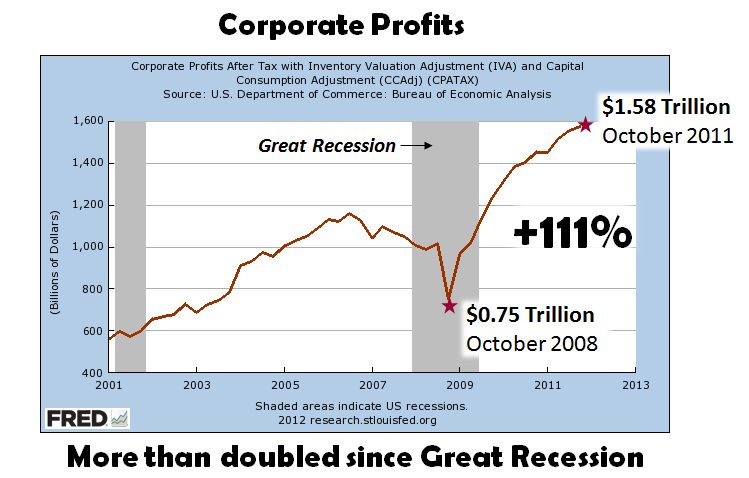
This “Corporate Profits” graph shows that corporate profits have more than doubled (+111%) from $0.75 trillion ($750 billion) in 2008 to $1.58 trillion in October 2011 (latest available data as of May 2012).  According to BEA and FRED, US corporate profits are now the highest in US history.  Since major corporations are bulwark of our economy, this is very good news.
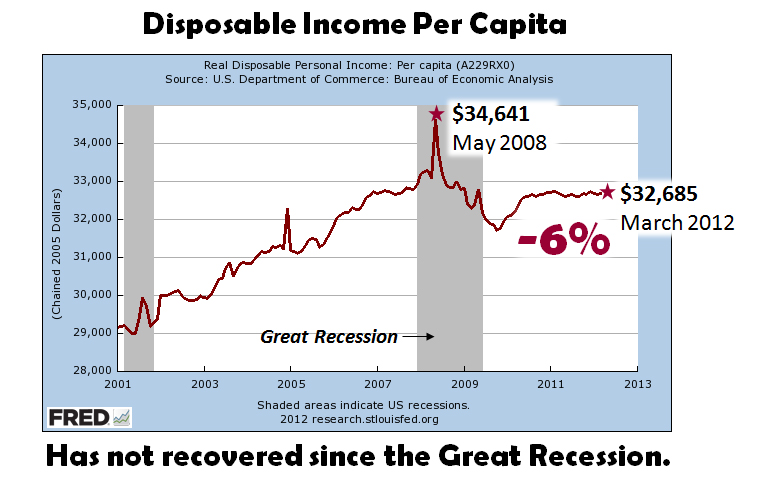
In contrast, the “Disposable Income Per Capita” graph shows that the average American citizen (per capita or each individual) has decreased -6% over the same period of time from a high of $34,641 in May 2008 to $32,685 in March 2012.   Real disposable income per capita income is the portion of personal income that is left after personal taxes are subtracted, and thus is the amount of personal income available to people for consumption spending and saving.    Real disposable income per capita income is also an indicator of a country’s standard of living.

So why does Jobenomics make the assertion that the future of US big business depends on deploying its resources to increase America’s overall standard of living?
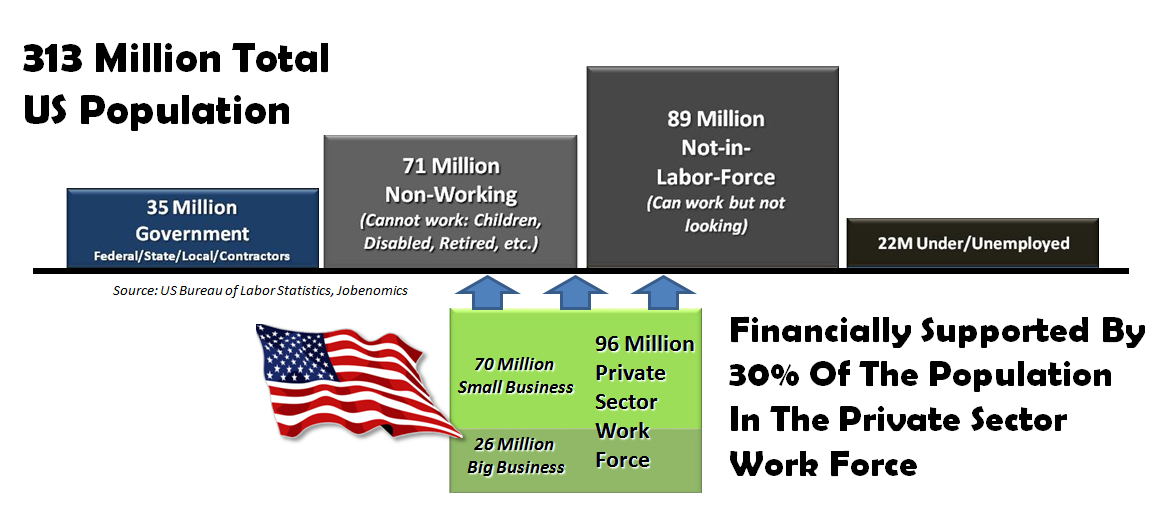
Today, the US population is 313 million people with only 96 million in the private sector work force.  These 96 million via familial obligations or paying taxes financially support:

  • 89 million who can work but are not looking
  • 71 million who cannot work due to age, disability, care-giving, etc.
  • 35 million who work for the government.
  • 22 million under/unemployed who are looking for work.

Since the Great Recession of 2008, the private sector work force has decreased by almost 5 million people while those “Not-in-Labor-Force” has grown over 9 million alone.  In other words, too few are paying for too many.

Of the 96 million people in the private sector labor force, the majority (70 million) are employed by small business that was hit hard by the Great Recession.  To make matters worse, small business received almost none of the trillions of dollars of federal government stimuli, bailouts and buyouts that went mainly to large financial institutions and corporations.  Even though small business still struggles with adverse lending conditions, this community single-handedly produces almost all (95%) of the new American jobs.  The following chart shows the contribution to the US labor force since the beginning of this decade.  Small business generated 3,266,000 new jobs, whereas big business produced a meager 168,000 jobs.
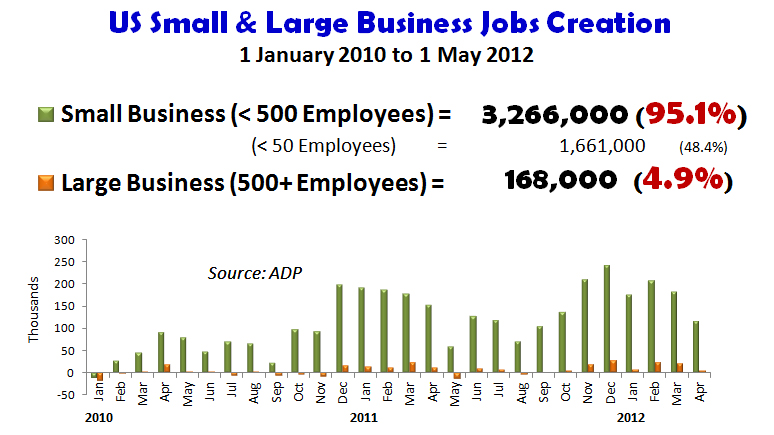
In many ways, the Great Recession contributed to making American corporations the most productive businesses in the world.  Downsizing and eliminating non-productive operations was important for global competitiveness.  Now that big business is economically stable, it is time that it becomes socially more responsive.

If big business continues on its current path of hoarding profits and deploying resources overseas in rapidly growing emerging economies, it will face increasing hostility from the American public who are most interested in domestic growth and jobs.   Joblessness, income inequality and budget deficits are already major issues.  Eventually, corporate taxes will have to rise significantly to cover trillion dollar tax revenue shortfalls that are needed largely for entitlement and welfare payments.   As evidenced by recent European elections, electorates favor increased taxes over austerity programs.  Corporations have a simple choice either to deploy their profits in ways that create win-win scenarios, or let government bureaucrats tax their profits and use the proceeds that best suits government priorites that often emphasize social over economic issues.

From a Jobenomics perspective, big business should consider small, emerging and self-employed business creation as one of their primary means of deploying a portion of their profits for the common good.  While this may seem counterintuitive, small business creation offers many benefits for big business.  First it grows the base (96 million) of the private sector work force, which is needed to support government programs and the needs of the non-working population.   Second, it grows consumers whose purchasing power represents 70% US GDP.  Consumption powers the economy. Decreased consumption public and investor confidence and adversely impacts stock markets.  Third, small businesses are more apt to hire the unemployed, thereby alleviating pressure on big businesses to hire unnecessary workers.  And lastly, big businesses could benefit from alliances with the small business community to provide specialized skills on a subcontractor basis as well as being public relations advocates for big business that support small business and jobs creation.

Jobenomics offers one example for big business to consider.   Jobenomics Harlem is our leading community-based business generator that is designed to produce 1,000 new businesses per year in inner-city Harlem, New York (see Jobenomics Harlem posting).   Jobenomics Harlem has secured a micro-business loan from a leading bank for $20 million with a limit of $50,000 for each individual loan.   Since Jobenomics intends to clone this program in a hundred other cities, major corporations may want to sponsor a community-based business generator, underwrite micro-business loans, and use their human resources for mentoring and training of new small business tailored to their industry.  Energy companies would sponsor green-business and jobs creation opportunities.  Industrial companies would sponsor new business specializing in trades most needed in manufacturing.

Many major corporations complain that they are having trouble finding skilled labor for 21th Century jobs.   Community-based business generators could focus on training, certifying and starting small businesses to meet the future needs of big business.  Not only would corporations help America’s economic recovery, but enhance their public relations while recouping their investments via repayment of the micro-business loans.   What small and emerging businesses need most is “patient capital” and sponsors who understand how business works.   Business creation should be a role for business as opposed to government.   Corporations would be able to get government support and incentives for sponsoring community-based business generations.  The Jobenomics team discussed with leading policy-makers the possibility of tax breaks for corporations that repatriate foreign profits for efforts such as this.  Their response was very positive.

In conclusion, America’s biggest corporations have largely recovered from the Great Recession.  It is now time for them to help others not as fortunate.  If corporations fail to do so, voters and legislators will target corporate profits as a major source of tax revenue.  Rather than have government bureaucrats deploy their capital, it seems that corporations would prefer to invest in projects like the Jobenomics community-based business generators.

Share this:
Share this page via Email Share this page via Stumble Upon Share this page via Digg this Share this page via Facebook Share this page via Twitter